
Household hazardous waste in Toronto
Paint, propane, batteries and cleaning products do not go in the garbage. This guide covers the City of Toronto's free Toxic Taxi pickup, the depots that take hazardous waste and what we leave for you to sort out first. We are a private junk removal company, not the City.
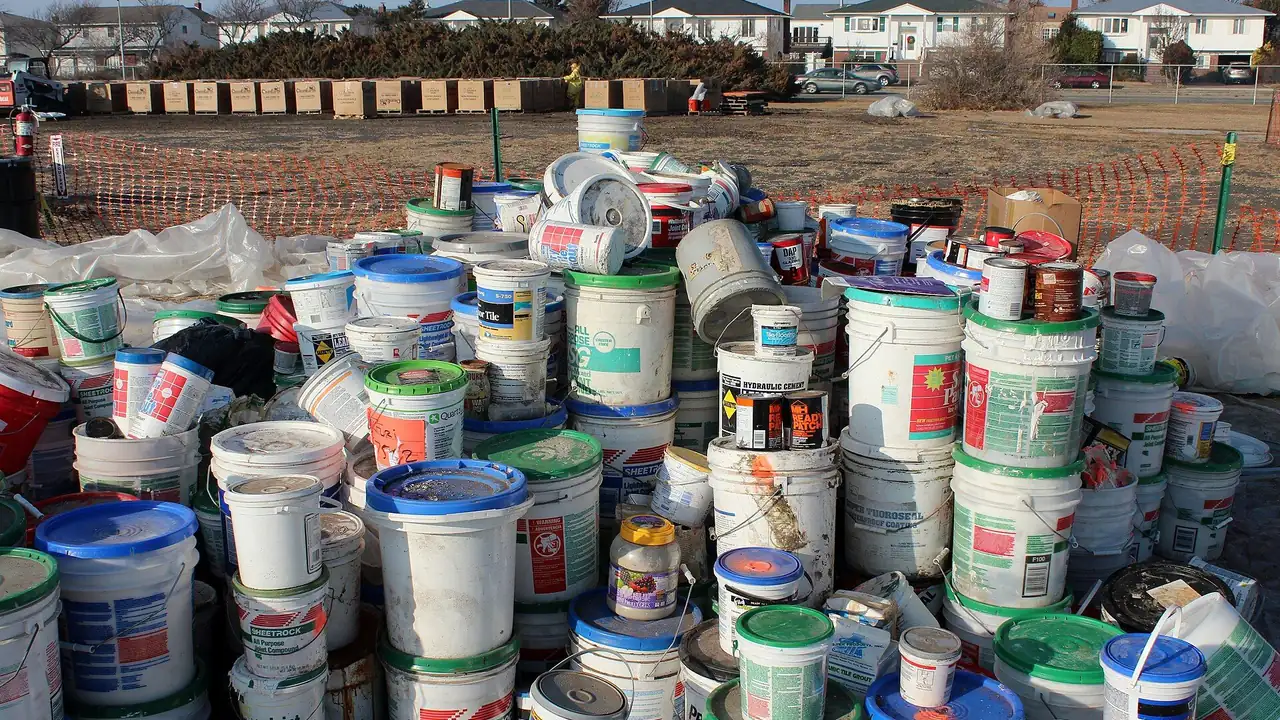
How to book the Toxic Taxi in Toronto
The Toxic Taxi is the City of Toronto's free pickup for household hazardous waste. You book it by submitting a service request to 311, either online or by phone, and the City collects from your home on the scheduled day. Nobody has to drive anything to a depot.
It only works for a certain size of pile. The City sets a minimum of 10 litres or kilograms and a maximum of 50 litres or kilograms per pickup. That amount is counted from the volume printed on the containers, not from how full they are, so five nearly empty 4 litre paint cans count as 20 litres.
As of October 2026, the City limits the service to its residential waste customers. For a City-serviced multi-residential building, property managers or building staff must schedule the appointment. Check the City's Household Hazardous Waste page or call 311 for the booking details before you set anything out.
| Detail | Toxic Taxi |
|---|---|
| Cost | Free |
| How to book | Online service request or 311 |
| Amount per pickup | Minimum 10 litres or kilograms, maximum 50 litres or kilograms |
| Who can use it | The City's residential waste customers |
| Container | Open-topped, such as a cardboard box. Not a bag |
| Where to set it out | On private property, in front of the residence on the street address side, by 7 a.m. on the scheduled day |
| Liquids | Sealed, non-leaking containers. Paint cans must have a lid |
| Mixing | Keep types apart. Batteries, paint and bulbs go in separate containers |
What counts as household hazardous waste
The City defines household hazardous waste as anything corrosive, flammable, explosive or poisonous. It cannot go in the garbage, the Blue Bin, the Green Bin or down a drain, toilet or sewer. The reason the City gives is that it can hurt workers and start fires and explosions in collection vehicles and at waste facilities.
The City's list is long. These are the groups most people run into when they clear a garage, basement or shed.
- Paints and finishes: latex, acrylic and oil paints, including empty paint cans, plus primers, stains, spray paints, paint strippers, thinners, turpentine, solvents, glue and wood preservatives.
- Car and garage products: antifreeze, brake fluid, windshield washer fluid, motor oil and oil filters, fuel, body fillers and car batteries.
- Household cleaners: bleach, ammonia-based cleaners, drain cleaners, oven and metal cleaners, disinfectants, floor and furniture polish.
- Pesticides and garden products: fertilizers, weed killers, insecticides, fungicides and poisons for ants, rats or bugs.
- Gas tanks and cylinders: propane and barbecue tanks, helium and oxygen. Also fire extinguishers and lighter fluid.
- Batteries of all types under 5 kg each, and all light bulbs, including LED, CFL, halogen and fluorescent tubes.
- Other items: aerosol cans that are not empty, mercury thermometers, moth balls, swimming pool chemicals, and large quantities of cooking oil.
Which City depots take hazardous waste
Six of the City's seven drop-off depots take household hazardous waste. Dufferin does not, and it does not take electronic waste either. Drop-off from residential sources is free, up to 50 litres or 50 kilograms in total per day.
The City publishes separate hours for hazardous waste. On weekdays they are shorter than the rest of a depot, so a depot that opens at 6 a.m. for garbage will not take paint until 10 a.m. Hours below are as of October 25, 2026, and the City notes that hours may vary on holidays.
Two notices matter right now. The City says household hazardous waste is not accepted at the Disco depot from October 13 to 26 because of repair work, although the depot stays open for other materials. Call 311 to confirm it takes hazardous waste again before you go. And from October 26 to December 18, expect delays at Commissioners because of tipping floor repairs. The guide to all Toronto transfer stations covers how a depot visit works in general.
| Depot | Address | Monday | Tuesday to Friday | Saturday | Sunday |
|---|---|---|---|---|---|
| Bermondsey | 188 Bermondsey Road | 10 a.m. to 6 p.m. | 10 a.m. to 6 p.m. | 7 a.m. to 12:30 p.m. | Closed |
| Commissioners | 400 Commissioners Street | Closed | 10 a.m. to 6 p.m. | 7 a.m. to 12:30 p.m. | Closed |
| Disco | 120 Disco Road | Closed | 10 a.m. to 6 p.m. | 7 a.m. to 12:30 p.m. | Closed |
| Ingram | 50 Ingram Drive | 10 a.m. to 6 p.m. | 10 a.m. to 6 p.m. | 7 a.m. to 12:30 p.m. | Closed |
| Scarborough | 1 Transfer Place | Closed | 10 a.m. to 6 p.m. | 7 a.m. to 12:30 p.m. | Closed |
| Victoria Park | 3350 Victoria Park Avenue | Closed | 10 a.m. to 6 p.m. | 7 a.m. to 12:30 p.m. | Closed |
| Dufferin | 35 Vanley Crescent | Does not take hazardous waste | Does not take hazardous waste | Closed | Closed |
Daily limits at a depot
The City caps what one visit can bring. The limit is 50 litres or 50 kilograms of household hazardous waste in total per day. The City also lists limits of 20 fluorescent tubes, 100 compact fluorescent lamps and 5 gas tanks such as propane or helium, and its limit list also names any container over 20 litres in volume, so call 311 before bringing a larger one.
Community Environment Days
The City also runs Community Environment Days where you can drop off household hazardous waste and electronic waste, up to 50 litres or 50 kilograms in total. They run from April to the end of September, so there are none left this year. Check the City's page in spring for the next dates.
Paint disposal in Toronto
Paint is household hazardous waste in Toronto. The City lists latex, acrylic and oil paints, and it includes empty paint cans in the same group. That means the cans in the corner of your garage go to a depot or the Toxic Taxi, not into the garbage.
Follow the City's packing rules so the load is accepted. Return products in their original containers where you can and keep the lids sealed. Label any container that is not the original, and do not mix different paints into one container. For the Toxic Taxi, paint goes in an open-topped box, separate from batteries and bulbs.
Do not leave paint in a car for long, particularly in hot weather. Drive it straight to a depot on the day. If you are clearing a room before a renovation, plan the paint run as its own trip, using the hours in the table above.
If you are clearing a space, we can haul the junk, but the paint has to come out first. Our garbage removal in Toronto page shows what a typical pickup includes.
Propane tanks, batteries and bulbs
These three catch people out because they look harmless. All three are on the City's household hazardous waste list.
Propane and other gas tanks
The City lists gas tanks and cylinders, including propane for barbecues, helium and oxygen, as household hazardous waste. Depots take them, up to 5 gas tanks per day. Do not put them in the garbage. The City warns that hazardous waste can cause fires and explosions in collection vehicles.
Batteries
The City accepts all types of batteries under 5 kg each, including household and vehicle batteries. A battery still attached to a device is not accepted, so take it out first. To store them safely before drop-off or pickup, keep them in their original packaging, wrap several together in a clear plastic bag, or cover the positive terminal with clear packing tape, duct tape or electrical tape.
Light bulbs and tubes
The City now lists all bulbs as hazardous waste, not only the mercury ones. That covers incandescent, LED, halogen, CFL and fluorescent bulbs. Pack them so they do not break. Fluorescent tubes need to be in the original box or taped together in groups of 8. The Toxic Taxi does not pick up tubes 8 feet or longer, so take those to a depot.
Electronics, medication and sharps
The City handles electronic waste as its own category, not as household hazardous waste. It still goes to the same six depots, in the same hours, and it is free. The City also collects electronics from houses on garbage day: set them out 0.5 metre (2 feet) away from your garbage bin, large items such as monitors and televisions on the ground, and small items in a clear plastic bag or open cardboard box. Remove batteries first, since a device with its batteries attached is not accepted.
Accepted items include televisions, monitors, computers, printers, phones, stereos and game consoles. Appliances such as fridges and microwaves, vacuum cleaners, air conditioners, power tools, string lights and batteries are not electronic waste. Clear your personal data off any device before it leaves your hands.
Medications, vitamins and medical sharps are on the City's list too, but the City points people to participating pharmacies for them. Needles and syringes must be in a puncture-proof container, sealed and labelled, and the City does not return the container.
Why we do not take hazardous waste, and what we do haul
We do not take paint, propane, chemicals or asbestos. Those need to go to a City depot or the Toxic Taxi, and the City says its depots do not accept asbestos and tells residents to contact a private company for it. Pull those items out of the pile before we arrive.
We haul junk across Toronto and the GTA. Demolition and tear-out is in the City of Toronto only. We try to recycle what we can.
Prices are posted before 13% HST. The smallest load, the minimum pickup, is $119, and it covers up to 1 cu yd. A half load is $389 and a full load of about 16 cubic yards is $599, with 1,000 kg included. The junk removal cost guide explains how each load is priced.
Send photos for a quote. We confirm the volume on site, and the price is set by the load. Not sure whether something on your pile is hazardous? Include it in the photo and ask. Same-day service is available for an extra charge when the schedule allows.
Questions about household hazardous waste
Yes. The City of Toronto lists it as a free pickup for household hazardous waste. You book through 311 or an online service request, and each pickup takes between 10 and 50 litres or kilograms.
10 litres or kilograms, up to a maximum of 50 litres or kilograms per pickup. The City counts the volume printed on the containers, not how full they are. For a smaller amount, bring it to a depot.
No. The City lists latex, acrylic and oil paints, including empty paint cans, as household hazardous waste. Take them to a depot that takes hazardous waste or set them out for the Toxic Taxi.
To a City depot that takes household hazardous waste, up to 5 gas tanks per day. Dufferin does not take hazardous waste. Check the table above for the hours and call 311 if you are unsure.
The City says drop-off from residential sources is free of charge, up to 50 litres or 50 kilograms in total per day. Its fees page lists hazardous waste as free. The minimum $40 deposit and per-tonne fees apply to charged loads such as garbage and renovation waste, and the City says hazardous waste does not need to be weighed.
No. As of October 2026 every depot that takes hazardous waste is closed on Sundays. Saturday hours are 7 a.m. to 12:30 p.m., and weekday hours are 10 a.m. to 6 p.m. Commissioners, Disco, Scarborough and Victoria Park are closed on Mondays, while Bermondsey and Ingram are open.
No. We do not take paint, propane, chemicals or asbestos. Take those to a City depot or book the Toxic Taxi, and we will haul the rest of the load.
Send photos, get a price
Tell us what needs to go. We reply with a price from the posted rates.
Get your price by phone
Call and we price your job from the posted rates.
Pick a size to see its posted price.
What to tell us when you call
- What needs to go
- Which floor it is on
- Stairs or an elevator
- Your postal code